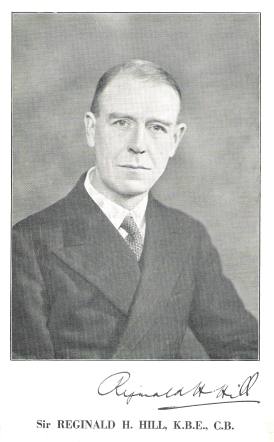
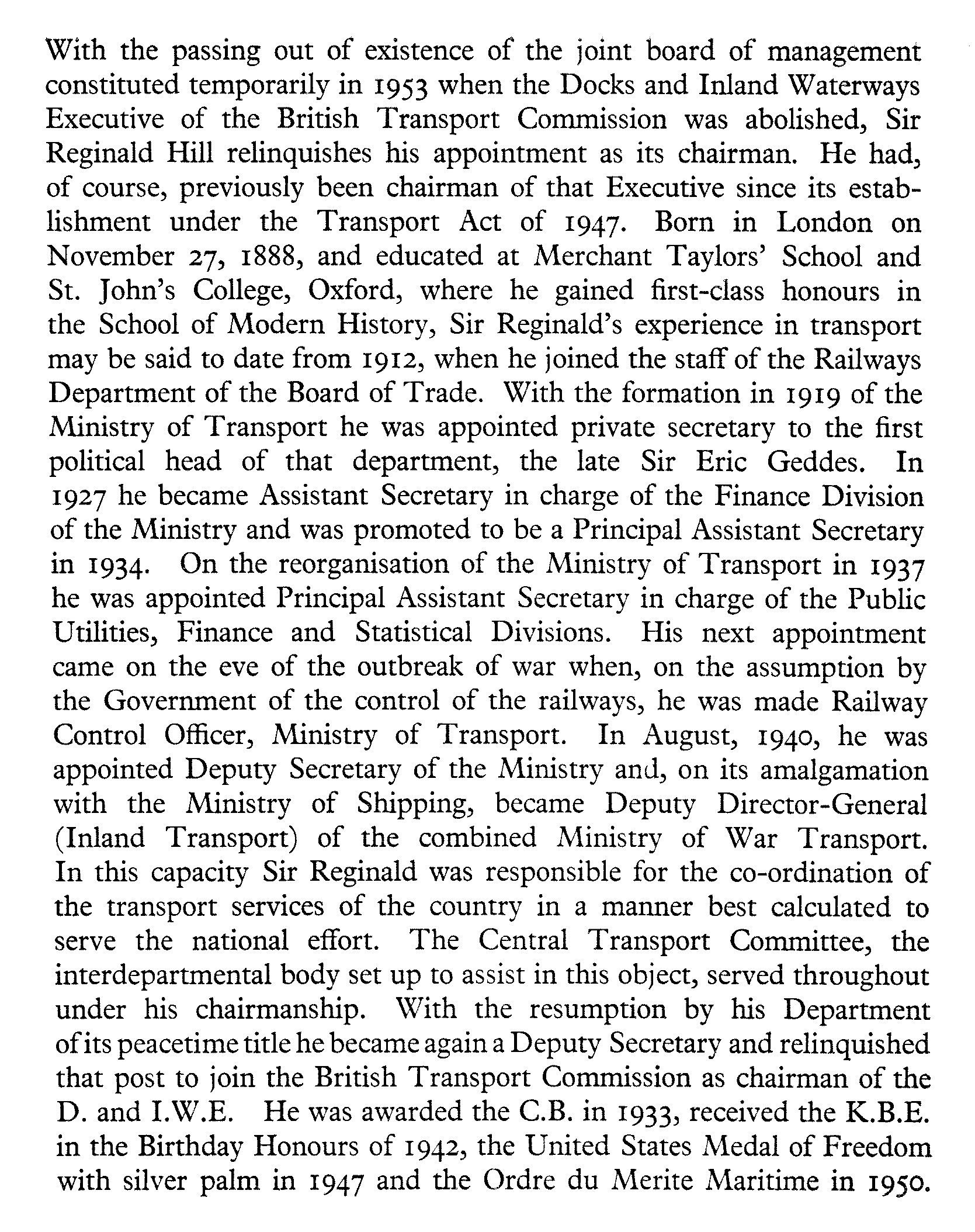
This page contains an epic poem written by my Grandfather, Reginald Hill, called "The Munbiad". That's my Grandfather's picture below the menu on the left. Below that is an article that describes his career with Great Britain's Ministry of Transport. (click on the article copy for a more readable image of it)
This document was passed along to me by my mother probably in the mid-1970s, but without any interpretation of it. Unfortunately, the people who could have explained the story in detail left us many years ago, but I am researching names and places as time permits and I will add my notes on the right side as I learn more.
The story appears to be a mock heroic narrative poem, inspired by Alexander Pope's "The Dunciad", about a history and literature study group which he undertook after his retirement with eleven colleagues led by a tutor named Munby. I have reproduced the document verbatim here, marking where pages began and including the footnotes he wrote into the document margins. All of the black print is copy from the original 24 page document. The blue italicized text was added by me for explanation or interpretation.
As a side note: one of my songs, "Words Across The Ages" in the "Blue Sky Days" Collection off my Home Page, was written around a rhyme by this same grandfather. Just as "The Munbiad" was inspired by a work of Alexander Pope, the rhyme, written for my 4th birthday, was inspired by Rudyard Kipling's "If". My sister Christine found it in some papers around 2005 and sent it to me. I did not remember ever having seen it and decided to incorporate his rhyme in a song. In effect, we co-wrote the song across a 50-year time span! I will post a recording of "Words Across the Ages" in the collection when I've completed the studio work on it.
If you recognize references in the document that I have not noted in italics, please feel free to contact me with the information and I'll add it to the page.
full manuscript in printable (pdf) form
|
(page 1)
|
|
The Munbiad
|
|
Book I
|
|
|
Of Cleo and her fav’rite son Ising,
Patron and oracle of that pure spring,
Of knowledge, whence a balanced judgment flows
To view all present, past and future woes.
Fear not the stoney bed of History’s stream,
Its turbid waters, shoals and deeps extreme;
Nor, following its course, to lose your way,
But seek a guide from W.E.A.
From Langley Royal an earnest little band
To range this river’s pregnant course had planned.
By reason led, had asked Th’ Association
To guide their pilgrimage of exploration:
It asked the Muse to tender her advice.
“Munby” she answered, and repeated twice,
“Munby, my dear son, serving at my side,”
“Munby’s my choice to be your pilgrims’ guide”.
“He, o’er their mazy wanderings shall hold sway”
“And keep them in the straight and narrow way”.
So, all acclaimed, their leader they anoint
And dates and hours and meeting place appoint.
Then he, with forethought, having mapped the route,
Summons the pilgrims to attend a moot;
And here surrounded by th’expectant group,
It seems convenient to review the troop.
First, Robinson, the C.O. of the band,
Of speech persuasive, waves a graceful hand.
Once soldier, now successful business man,
Can well dissect a strategy (or plan)
And teach, as warrior or executive,
To win a battle, or by commerce live.
A worthy next, meet Tisdell, Chatelaine
Of Peters Field, whereat our pilgrim train
Assembles for its weekly exercise.
The generous hostess, practical and wise,
Knows that men cannot live on words alone
Or, unrefreshed, sustain the learned toe.
Here’s learned Fisher, equally arrayed
To couch a lancet or to wield a space,
Apothecary, archiologist,
Physician, needing no apologist.
From well stored memory never fails to quote
Some local site, or curious anecdote.
|
Cleo - The Greek muse of history
|
(page 2)
|
|
|
Two Deans there are by matrimony “clanned”,
With pencils poised and paper in each hand;
Recording angels, with no sins to frame.
As Gwen and Dorothea known to fame.
In ingle nook three ladies may be seen
Now of a lively, now severer, mien.
Mawson to philosophic thought devout
Sustains a “Dialogue” to frame a doubt
And, like grave Pallas, erring man confounds;
Which done, fair Kinloch flings him to the hounds:
For Kinloch rebel’s role delights to play,
Challenge the field and so provoke affray.
Of all great Clio’s votaries, none more keen
That Jean McGavin (authoress) is seen;
Like the small voice of Conscience, she’ll exhort
To tame Tradition by progressive thought.
Eleanor Robinson, the Colonel’s wife
And leader of Kings Langley’s social life,
The arbitress of fashion’s changing whim,
Slave of the crown; but mistress of the brim.
Two Muses serves and dearly loves to please
With Terpsichore infrequent hours of ease.
Then Spence a pilgrim all too rarely heard;
But when she speaks reveals the witty word.
And now meet Moss, who walks with leftish list,
Gives to the past a futuristic twist
And, with a mild, but subtly quizzing, crack
Stretches the ancients on a modern rack.
And lastly Hill, who to the right inclines
On history trained and Civil Service lines
Though long retired, and somewhat long in tooth,
Still interested in the search for truth
And shows the younger pilgrims how to gauge
The golden glories of th’Edwardian age.
|
Pallas - The Greek goddess of wisdom
King's Langley - a village 21 miles from London
|
(page 3)
|
|
Book II
|
|
|
Now all are ready; but the gods require
Some offering of those who would aspire
To scale Parnassian heights; so Clio speaks.
“None, empty handed, shall attain the peaks”.
Bids Munby, by an ordinance divine,
To each a private labour to assign,
To form libation at th’appropriate shrine.
(Some essayed theme, which he or she recite
To the Assembly, on the appointed night).
By this condition some appear distressed;
But set about their homework with a zest.
That settled, Munby leads his little band,
Impatient to explore a Promised Land,
And, as they journey, vivid backgrounds sketches
Far back to palaeolithic times he stretches
Shows, through the struggling ages of Mankind,
Meandering Progress, blundering and blind,
‘Cross severing sea and desert, creed and race,
‘Tis possible some rational links to trace.
See ancient civ’lisations rise and fall!
See Hittites crumble, Alexander sprawl!
Till Tartar Empire near engulfs them all.
Yet linger o’er the beauty that was Greece,
Wrapped in the ruins of her Golden Fleece,
Where, proud survivors of an age sublime,
Ionian columns yet defy Old Time
And, mute reminders of the Classic mind,
Brood over humans of a lesser kind.
Watch Rome wax great, hold the known world in fee
Then slowly wither like some stricken tree;
For lack of virtue totter to her doom,
Corrupt and bankrupt, mid the encroaching gloom.
Till bleak barbarians bid the curtain fall
And universal Darkness buries all.
Through Shadowed Ages fearfully they move
But Munby cheers with songs of Courtly Love,
Till wakening Art and Learning rise again,
Renaissance dawns, and man renews the chain.
|
Parnassian - relating to poetry: from the 19th century French anthology "Le Parnasse contemporain" (1866).
|
(page 4)
|
|
Book III
|
|
|
Against such changing scenes the pilgrims strode,
Lost not the beacon lure that lit their road,
Zeal, Hope and Munby kept their footsteps straight
And let them, stern of purpose, firm of gait.
So come they to their first objective shrine,
Where Art and Nature blissfully combine
Olympian spendours in th’Hellenic Isles.
Here, as decreed, McGavin Zeus beguiles.
Homer accepts her off’ring and applauds,
Strikes on his lyre soft valedictory chords,
Then introduces the Hellenic lords.
Says wily Ulysses “’tis odd to me
“That folk yet hanker after Odyssey”.
Then, seeing Circe, fails to recollect her,
While poor Penelope hands round the nectar.
Pallas presided at the ensuing feast
Till rosy fingered dawn show in the East.
|
|
|
Thence, ferried o’er th’Aegean by aged Charon, **A
They reach the mainland, where they find a war on.
Athenians and Spartans both invite
Munby to show them how the moderns fight:
Referred to Robinson they quickly learn
Each other’s faulty tactics to discern,
Before engaging, to advance the Scout
(To find out what the other side’s about),
To ditch the phalanx and protect the flank,
Replace the cavalry with armoured tank,
Rearm the hoplite with a Lewis gun,
(Which ends the battle o’er it had begun).
And since both practiced what they had been told
The armies melted – but the war went ‘cold’.
Meanwhile to Hill a different task assigned
To keep each polis to its walls confined, **A2
To blunt the edge of demagogic lies
By skilful use of right to ostracise,
To oligarch and democrat suggest
That which is best administered is best,
And so, by keeping politicians cool,
Teach local patriots not to play the fool.
Their mission ended, they obtain release,
Leaving Thucydides and Greece at peace.
|
Note **A: Strangely off his usual beat. Probably things were quiet on the Styx at the time and he was seeking to supplement his earnings ‘on the side’.
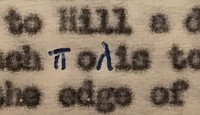
Note **A2: The letters of “P” and “L” in the word POLIS (greek word for city), were replaced by greek letters “pi” and “lambda” in the manuscript (see image of original above).
Thucydides - an ancient Greek historian
|
(page 5)
|
|
|
The backcloth changes: where, mid Northern mists,
Pierce flaxen tribes the Roman arms resist.
Here Varus’ Legions vainly fought and died
To bring humiliation on their side.
See here, on Berg that frowns upon the Rhine
The Teuton warriors at their ease recline,
While Dorothea, to many a lusty “Heil!”,
Expounds ‘Germania’ in Brunhilde style,
A heavy task, for Tacitus’ prose
To idiom heroic hardly grows
Or epic phrenzy, loved of those who sung
The savage stories of the Niebelung.
Yet farther north, to drearier clime they go,
Where awful magic rules in winter’s snow,
Dragons and loathly, treasure guarding, worms
Breathe poisonous fumes of devastating themes.
Androm’da-like as chained to rocky wall,
Behold Gwen throned in Hrothgar’s vasty hall,
Whence horrifying Grendel nightly steals
The sleeping warriors for her grisly meals.
But Truth and Innocence prevail tonight,
Keep Grundel and the dragons out of sight;
The hero Beowulf forgets hislager
While listening to the Gwendolinian Saga,
Consigns all monsters to the ‘once-has-been’
And vows to fight for no-one but a Dean.
In course the pilgrims come to Elsinore,
Where dark Melpomene controls the door,
But find, upon these battlemented coasts,
No living souls, but regiments of ghosts.
(Since Shakespeare here a holocaust created
The neighbourhood is quite depopulated).
Yet ghosts, ‘tis known, will talk and often curse
Sometimes in prose, but pref’ably blank verse.
So, Eleanor, the chosen priestess here
Invites a spectral party to good cheer
(Nor overlooks the sextons and poor Yorick
In case the party turn a trifle choleric)
To meet within that ruined castle hall
Where once ‘the Play’ applied to guilt the gall.
First Rosencrantz and Guildenstern arrive
(They never missed a party when alive),
Polonius next (they have removed the arras
Fearing it might the poor old man embarrass).
|
Tacitus - a historian of the Roman Empire
Grendel - the man-eating character from Beowulf feared by all but Beowulf himself
|
(page 6)
|
|
|
Not knowing modern drinks, he chose ‘Old Fashioned’,
Which made his harmless chatter quite impassioned.
Ophelia chose gin – ‘but please no water’:
Polonius having sto’len a draught from daughter
The mixture shortly laid him on his back.
Laertes wisely stuck to simple ‘sack’.
More guests materialize, their gracious host
Flits cheerfully from thirsty ghost to ghost
Seeing that each is plenteously supplied.
The ‘late King’, fully armed, she draws aside
And deftly steers King Claudius and his wife
Away from Hamlet’s father’s carving knife.
When asked, the latter simply answers ‘bitters’
In tones to give the other guests the jitters:
But Claudius and Gertrude (guzzling slatterns)
Are satisfied with nothing but Manhattans.
Last to appear, in inky cloak enrapt,
Unshaven, mired, ungartered and uncapt,
Hamlet, irresolute, on threshold stands,
Ignores the hospitably proferred hands
Exclaims ‘”O my prophetic soul” my sister!’
Then swoons beneath a neighb’ring aspidistra.
‘Water!’ they cry and try to lift him up,
Sly Claudius hastens forward with a cup.
But Hamlet, not as senseless as they think,
Empties the poisoned goblet down the sink. **B
Revived – by Scotch and gales from N.N.W.,
Hamlet soliloquises – ‘By Request’
On ‘Are the lives of worms or men less blessed?’.
That over: those who still remained awake,
For food and drinks, or mere politeness sake,
Float round to hear their hostess on the theme
‘Was Hamlet mad, or did he merely seem?:
A problem unresolved; for Chanticleer,
Presently showed ‘the matin to be near’.
Wherest the spectres dematerialize,
O’er Elsinore the shrouding mists arise
And sullen solitude to silver’d silence sighs.
Now move to Venice, to pick up the trail
The Polos blazed to pierce the Eastern veil.
By hard and perilous marches they make haste
Across the awful Asiatic waste
Of steppe and snow girt highlands, inland seas
And haunted deserts that now scorch, now freeze,
Along the ancient routes the merchants trod,
With Eastern wealth, beladen camels plod.
|
Note **B: Probably poetic license. There would not, it is thought, be a sink in the Hall: but, as previously stated, there was an aspidistra, no doubt provided by the caterers, which would do as well.
|
(page 7)
|
|
|
So came they to the wonders of Cathay,
A mighty empire ‘neath Mongolian sway
And, having penetrated The Great Wall,
On the Great Khan they pay a formal call.
By Mawson’s learned discourse well impressed
Kubla received them kindly and confessed
Keen interest in Western thought and art
And swore he could not bear them to depart.
But pilgrims must for ever onward move
Lest fixed assignments zeal, abating prove.
For fear the eager Khan might take the course
Of holding them, for questioning, by force,
They feign compliance, from the Palace slip,
And at Amoy embark upon a ship.
Thence, after seeing Hindustan in brief,
They rest awhile with Persia’s proud Caliph.
This long trek ended, they observe once more
The blue sea lapping on Italia’s shore.
How fleeting peace! How prevalent distress!
They find Italia in a sorry mess.
By Arno’s banks the rival factions glower;
As Guelf and Ghibelline contend for power,
Emp’ror and Pope combine but to betray
The Hope they crowned at Aix on Christmas Day,
With infidel and heretic in league
Debauch their sacred office with intrigue
And blood : till Florentines exclaim “To Hell
With both your parties, give us Machiavel!”
Dismay’d our pilgrims flee the embattled camp
And find, in Dante, him who holds the lamp
That lights the crossroads – one to Bliss Eternal,
The other to the Circles Nine Infernal.
With him as guide they plomb that damned ‘well’
From Limbo, where the virtuous pagans dwell
In reasonable comfort, without hope,
Who to Truth, unrevealed, could only grope.
(These Dante named ‘the master souls of time’
For ‘born too early’ was their only crime).
Through all the grades of torment make descent,
Where sinners can’t amend or e’en repent,
To Cocytus, the deepest pit, they go
Where Satan stands, the universal, Foe
Condemned, in icy waste, to everlasting woe.
|
Cathay - an alternate name for China in English
Guelf and Ghibelline - two 12th century Italian city-states
Cocytus - a river from Greek mythology which is on the way to Hades
|
(page 8)
|
|
|
Mankind, although enured to many toils,
From supernatural devilries recoils;
Our pilgrims, shaken by that awful dream,
Gladly embrace a less sulphureous theme,
Did Dante’s wan and fading shade farewell
And seek their boding consciences to quell,
By studying the opportunist tricks
Of fashionably current politics
Expounded by the author of ‘The Prince’.
Yet Casuistry’s logic can’t convince
Kinloch or Mawson or e’en reconcile
To cynical hypocrisy, or Borgia guile.
In Springtime wanderers’ thoughts revert to home,
The nodding jonquil, the expectant loam,
The unpruned rose-bush and the unmown lawn,
The hedgerows spangled by the burgeoning thorn.
So Munby sees around him eyes that yearn
For England, corresponding feet that spurn
The alien path: the unfamiliar strand
Creates nostalgia for their native land.
In sympathy, Fortuna will design
Their story, next, with Chaucer’s to entwine.
So Munby gladly leads them into Kent,
Where, very quickly, they pick up the scent;
For, as they walk the primrose bordered path,
Behold! Mine Host rides with the Wife of Bath
And all that troop to Canterbury bound,
Whose greeting hails right merrileye resound.
So, after parley, Munby’s band agree
To join awhile ‘this holy companye’,
And, since of tales good Chaucer’s running dry,
Promise some merry stories to supply.
Then each is mounted (pillion) on a horse
And all, in fellowship, resume their course.
Thus, as they travel, Spence her task recites
With wit that all the company delights
She makes the Clerk of Oxenford to laugh
So heartily he has to stop and quaff
And o’en the solemn Knight, with courtly bow,
Announces ‘tis a merry wench I vow’.
Too soon to Southwark come the cavalcade
At Tabard Inn farewells are duly bade
And after cups o’kindness for the road,
The Langley band move on to their abode.
|
|
(page 9)
|
|
|
It chanced about this time a pilgrim lone
Fled from Destruction (Beds), a danger zone;
But finding it too sloughy in those parts,
Had crossed the county boundary into Herts.
Proceeding south, he presently descried
Our friends advancing from the other side,
Who, meeting, he enquired with dismal dole,
Which way he ought to go to save his soul.
(Indeed it seemed he well might be undone
Seeing he walked along A.41)
But as they paused a swiftly passing car
Removed him to a destination far
Called Vanity, a new and glossy town, **C
Where, in its Fair, the driver set him down.
So ended Munby’s and his pupils’ quest,
All feel they need, and well deserve, a rest.
While each his recreative labours plies,
On Peter’s Field a brooding silence lies;
Those pleasant groves where Muse and Student meet
Deserted stand; o’er Munby’s weekly beat
Defiant Nature sweeps her weedy skirt,
Impatient her abhorrence to assert.
The nations, on their summits, seem to pause
And History puts her pen away – and snores.
|
Note **C: Internal evidence seems to identify this town with the modern Hemel Hempstead.
|
(page 10)
|
|
Book IV
|
|
|
Jove’s frolics cease; to eve from dewy morn
Abundant harvests flow from Ceres’ horn,
Diana takes her quiver from its hook,
And dryad’s weeds assume a russet look,
The schools reopen, following their rules
(And, incidentally, so do football pools).
So, now Minerva’s Long Vacation’s past:
Too long suspended study must not last
Lest that which soul and pulsing body linked
Should, like an old volcano, grow extinct.
To man’s unsated reason playthings pall,
It drops the toy and casts away the ball,
Demanding some more satisfying dole
Of mental food; some spiritual goal.
The W.E.A. supplies such needs,
Prepares the compost and supplies the seeds.
So now responsive to the call it came,
Returning Munby to fulfil its name.
As light from Phoebus’ fiery chariot streams,
Now Munby’s bus displays its rival beams:
O’er Peter’s Field the beckoning beacon’s rays
Summon the pilgrim flock to come and graze
And, led by Robinson, the faithful speed
To crop again that intellectual mead.
Munby allots to all their special jobs;
(But can’t find anyone to take on Hobbes).
Then, westwards sailing, o’er th’Atlantic waste,
As Cortes did, without unseemly haste;
Till, on the savage Caribbean shore,
They meet the Aztecs, steeped in human gore.
Tisdell and Robinson are told to make
The customary off’ring; how they quake
As to the temple’s summit they are led,
Where countless human sacrifices bled!
Happ’ly the Aztec priests are struck with awe
By Tisdell’s charm and Robinson’s firm jaw:
For ‘twas foretold such god-like beings would come
To rule in Mexico and make things hum.
(They thought that Quetzalcostl had returned,
That god for whose beneficence they yearned).
The pilgrim’s spokesmen, wisely, do not dally,
Their off’rings made, descend the Teocalli.
|
Ceres - Roman goddess of agriculture
|
(page 11)
|
|
|
The Emperor Montezuma, much impressed
By Munby’s knowledge, ranging East and West,
Of lands the Mexicans had never dreampt,
Was feeling somewhat barb’rous and unkempt.
(Besides, he’d fallen heavily for Mary
And of offending Robinson felt chary.)
Desiring to propitiate th’unknown,
Restore his amour-propre and keep his throne,
Orders refreshments, then displays his treasures,
Enrobes his visitors in gorgeous feathers,
Which all the ladies instantly adore,
(Especially the ‘hat-famed’ Eleanor).
So peacefully, they conquer Mexico,
At ease among its floating gardens row
And, having seen, as peacefully depart,
Leaving poor Montezuma with a broken heart.
Next, having crossed the ocean once again,
They find themselves in old Cervantes’ Spain.
A ‘clunking’ lifts the curtain on this drama,
Behold Quixote, clad in rusty armour,
Who, seeing Gwen beginning her address,
Assumes she is a damsel in distress,
Couches his lance and charges at a tree
The which, unmoving, lifts him from his gee.
The tender hearted Gwen arrives apace,
Her tears bedew the Don’s much wrinkled face.
This soothing salve, this sympathetic rain,
Confirming his illusions, calms his pain:
He rises, bows, and sings of Courtly Love,
Of dying to defend his Lady’s Glove.
The other pilgrims watch nostalgic’ly;
The last spark, faintly flickering, they see
Of dying mediaeval chivalry.
A fascinating feature of this kind
Of pilgrimage, gymnastics of the mind,
Which leaps to Gulliver from Machiavel
From Marco Polo to a glimpse of Hell!
‘Tis literary anarchy you think?
But continuity provides the link.
Of Montezuma, what would Chaucer say?
Or Pericles of Dante, Hobbes of Gay?
What view would Hamlet take of Quixote?
Such thoughts at these pass through some active brains
Till Munby Hobbes’ philosophy explains:
|
|
(page 12)
|
|
|
So forcing them to contemplate the span
And plumb the depths of ‘that Leviathan’.
Of Nature’s laws, of God, or man, or state,
The rights of subjects, or of potentate.
Was Nature’s state but elemental strife
In which men, ever fearful, milled for life,
Poor, solitary, nasty, brutish, short?
Has he, by contract, preservation bought?
Did he, in that supposed contractual hour
Barter his freedom to despotic power?
Is Liberty negation of the right
Of man to do according to his might?
Yet can man hope for any sort of health
Save in the shelter of a Commonwealth?
Can sov’reignty be other than supreme?
Must it reside in one, or can it in a team?
Such pregnant problems argument invite:
Much disputation stems from left and right.
While Hobbes’ sardonic spirit hovers o’er
And notes the points that the contestants score.
The shifting scene has reached th’ Augustan Age,
With Reason reigning in a classic cage:
Find satire-dominated verse and prose
Vying Society’s vices to expose.
The arteries of sentiment are harden’d
And only fools and dullness go unpardon’d.
For preface Munby tells the times of Anne
Of Whiggish latitudinarian
Of High Church Tory, pow’rful in the shires,
Of patronizing peers and sottish squires,
Of Marlborough’s victories, Jacobite defeat,
Enormous wigs; but very muddy feet,
Of specious opulence that ends in trouble
As Credit bursts in one great South Sea Bubble.
Unhappy genius to affliction tied!
Read Swft, with madness brooding at his side,
Chastising humbug with a scorpion scourge
Of irony, his fellow men to purge
Their priggish self-conceit, that they may see
Themselves as they to others seem to be.
As giant or pigmy – equally absurd
In action futile, insincere in word:
In vain pursuit fake learning chases straws,
Insensate Science fat’ous blueprints draws:
|
|
(page 13)
|
|
|
The Yahoo (man) appears as vilely coarse
Beside the cold perfection of the horse:
Nor can the wit of Gulliver bespan
The gulf between pure Reason and crude man.
Misanthropy leaves Mawson unimprest;
Although she likes the Brobdingnagian best
Knowing, full well, as every woman knows,
Though Titans bluster; Goddesses dispose.
Th’Augustan cult could hardly be complete
Without libation at Parnassus’ feet,
Where sits, fulfilling his most cherished hope
Of fame immortal, Alexander Pope.
A slave to pain, since first his life began,
That poor misshapen parody of man;
Yet, in that feeble frame, a spirit strong
Hustled his (often spluttering) pen along.
In spite of Nature proving so unkind,
To ‘Homer’ thanks, his pockets were well lined.
His thoughts on Man and Critics filled the Bill
Of Fare, directed to be served by Hill.
But first, poetic justice to accord,
Dryden armed Satire with the couplet sword.
His Abs’lom, by Achitophel, misled,
The epic form to controversy wed,
Showed how, with verse, the social sins to slay,
To ridicule the rogue and fools to flay.
At Twickenham the mustered pilgrims stand
See Pope’s shade limping through his garden planned,
Enter his grotto, where (by all accounts)
They’re nearly bitten by the ghost of Bounce. **D
The Rules for Criticism Pope advised
And neatly labeled ‘Nature methodised’
Are by the pilgrims’ spokesman criticized.
The shade waits grimly, till, a little stung,
It sadly murmurs “I was very young”.
But when it hears some slight to Aristotle
It promptly opens out its ghostly throttle
And, turning what (trans Styx) would pass for red,
Rumbles what sounds like ‘Angels fear to tread!’
More calmly to the State of Man ‘twill list
And smiles to hear itself termed ‘optimist’.
But o’er the end the shade begins to wane
And merges with the evening’s misty skein,
Repeating faintly, as it fades from sight,
“And don’t forget ‘Whatever is, is Right’!”
|
Note **D: Pope’s pet dog.
|
(page 14)
|
|
|
To show how easy couplets are to write,
Hill ventures verses a la Pope to site
And had the shade stayed longer, might have had
A place in that Rogues Gallery ‘The Dunciad’.
There came a day when Tisdall said “My friends
“Our course towards the Christmas ‘break’ now trends.
“Next week it is ordained we all go Gay
“And our respects to sweet Euterpe pay:
“So I invite you all to sup with me.”
All much applaud her generosity.
Thus, on that night, the pilgrims sit around
A laden board, with all good things well found;
Composed, contented, grateful and well lined,
Give thanks to Mary Tisdall hostess kind.
Then Munby introduces ‘poor’ John Gay
And records of his ‘opera’ they play.
The tuneful arias carry on the spree
Till Polly wins her lover from ‘The Tree’.
|
John Gay - English poet and dramatist best known for writing "The Beggar's Opera" (1728)
|
(page 15)
|
|
|
Be it a dollar, or a dismal dime,
Money, not poverty, ‘s the cause of crime.
Of greed the pander; usury the tool,
It blinds the miser and betrays the fool,
Is highly portable; and hard to trace,
The joy of thieves; the price of power and place.
Thoughts such as these the pilgrims minds assail,
Seeing reflected life in Fielding’s tale.
Of Jonathan Wild McGavin chats with verve.
Her playwright’s art and lively gestures serve
The subject wall and neatly skim the cream
From (some think) too monotonous a theme.
Did Wild deserve the epithet of ‘Great’
Or would ‘notorious’ better tell his fate?
Well! What is greatness? And how recognized?
Fielding – ‘insatiability’ surmised.
Mere hoggery! By most (let us confess)
‘Tis held synonymous with ‘great success’.
Yet neither definition wins assent
Greatness is not ‘corrupt aggrandisement’.
Although a lack of moral code prevail
From top to bottom of the social scale
And many, who court circles move among,
In humbler walks, at Tyburn would be strung!
Still, it seems grossly to exaggerate
To see, in the Prime Minister of State,
Walpole, for all his faults, another Wild,
(St. James’ thus with Newgate reconciled)
Or men of fashion, wit and consequence
Belikened to a double crossing ‘fence’.
So, lest the Rule of Nature you should mar,
Egalitarians, do not go too far!
For in Wild’s sordid death pretend to see
A worthy theme for sad Melpomene.
Long time they tarried in th’Augustan Age
Till Munby cried “It’s time to change the stage.
We’ll cross to France, enlightenment seek there
With Diderot, Montesquieu and Voltaire.”
Meanwhile the French had moved the other way
And learned in England what they had to say
From Bacon, Newton, Addison and Locke.
In France the Church and Court combined to block,
With censorship, this philosophic meal,
Or cool in exile or the grim Bastille.
But despots can’t afford to be effete:
The writers were not silenced – or discreet.
|
Jonathan Wild - an underworld boss of London: the main character of "The Life and Death of Jonathan Wild" (1743) a satiric novel by Henry Fielding
|
(page 16)
|
|
|
Atheist Diderot sought to create
Amoral Eden in a Godless state.
To Montesquieu, a country’s climate bore
Direct relation to its people’s law.
Irascible Voltaire, who, on and off,
Wrote plays and history or was philosophe,
With trenchant pen and conversation fought
To vindicate the liberty of thought.
By nature gamin, sceptic, epicure,
Ne’er could a martyr’s dietary endure.
Materialist ideals, for these he cared,
For revolution being unprepared.
Aimed at a Frederick, with Mikado fused,
Who’d keep his subjects busy – and amused. **E
In Europe ‘twas a transitory age,
Old faiths and loyalties had left the stage;
With little to believe and naught to praise,
Men wandered in a philosophic maze;
In catchwords sought relief: yet none had seen
The coming shadow of the guillotine!
Poor France! Half starved mid luxury, and pawned
To whores and selfish libertines, who fawned
Upon a feeble despot on her throne.
Her hope, the new philosophy – alone.
Appalled, the pilgrims hasten on their way,
For such conditions don’t invite delay
At Lake Geneva’s shore complete their journey
To interview the patriarch of Ferney.
Within his book-lined study shyly crowd,
Thinking to see him sitting in his shroud;
But find a living skeleton their host
(Voltaire would never tolerate a ghost).
Their spokesman Kinloch very wisely chosen,
Embraced her Voltaire moved by deep emotion
Declaring him the greatest of his age
(Which greatly pleased the venerable sage,
Who never could ensure a criticism)
He answers with a candid witticism,
Invites his visitors to take a chair
And favours them with skeletonic stare.
Soon he and she are lock’d in grave debate
(Both dearly loved to argue and check-mate).
The ev’ning falls, Voltaire turns on the lamps,
Discussion ranges – from internment camps
To garden digging, cannibals at sea;
|
Note **E:
“To make each prisoner pent
Unwillingly represent
A source of innocent merriment”.
|
(page 17)
|
|
|
Atomic bombs and whether wills are free.
Till Munby, seeing that its half past ten,
Closures the session firmly with ‘Amen’.
By way of change from philosophic doubt
And arguing ‘about it and about’,
Said Munby: “Let us sail in southern seas
With Cook to Papua and Polynese.
And Eleanor and Dorothea, by speech,
And I, with globe and film, the rest shall teach
Of Cook, his voyages and the part they played
In giving navigation science aid
We’ll range the oceans, Neptune’s secrets vent,
Survey and chart the Austral continent.”
No ‘Spanish Main’ adventurer was Cook,
No Drake or Raleigh, Jenkins, Bligh or Hook:
Discreet, humane and mindful for his crew,
The hazards of long months at sea he knew.
So Eleanor, as Q.M.G. the Ship,
Loads everything essential for the trip,
And first she lays in quantities of lime **F
‘Gainst salty diet in a torrid clime,
Of hard tack, briny port and beer and rum
Of aspirin, bully beef and chewing gum.
Then, womanlike, she takes especial care
To study what is best for each to wear
Straw hats and bikinis, sunglasses, jeans
And nylons to impress the island queens:
(Her chest includes a shark-proof diving suit,
Presented by the Women’s Institute).
‘Endeavour’, ‘Resolution’, ships so named
Their great commander’s qualities proclaimed.
No argosies: Indeed much undersized
To modern eyes – and yet immortalised.
Behold! Obedient to the capstan’s squeal,
They’re off and Dorothea takes the wheel.
Three times she circumnavigates the globe,
(Faster than satellites the heavens probe)
Then, having made this highly hustled tour
Returns the new found peoples to explore,
Renews, with Cook, the oceanic scene;
Which Munby illustrates upon the screen.
And first Tahiti claims a fleeting view
Where Nature smiles and human needs are few,
Tahiten maidens, beautiful and lush;
But not too innocent to raise a blush.
|
Note **F: Lime juice – not quick lime.
|
(page 18)
|
|
|
Such dalliance is not a pilgrim’s way,
Although the men evince a wish to stay.
New Zealand beckons o’er the isle-strewn sea
And shortly raises her volcanic scree.
So, while they line the bulwark, all agog,
Let’s quote from Dorothea’s well-kept log.
“Paddling to meet us in high prowed canoes
“I saw the Maories (governed by taboos.
“The comfort of an Act of Parliament
“As yet they knew not). Hostile the intent
“Their frightf’lly tattooed visages convey:
“I’m sure it would be most unwise to stay.
“No wonder such a sight my blood congealed.
“I simply long for home and Chipperfield!
So Cook decides along the shore to coast
In search of some less enterprising host.
Not finding one, again they westwards face
And in Australia see a different race
Of primitiveness; their special form of prang
That two-way argument – the boomerang.
Still mindful of a Southern Continent,
Cook sailed again Antarctic Circle bent
And in and out th’engirdling ice pack goes;
But finds no land but only floating floes.
A man was Cook of dedicated life,
With earth-bound secrets constantly at strife.
Perchance the North Pacific held the clue
To that long sought, elusive, seaway through
To China, from the North Atlantic shores;
Thus to escape Magellan’s snapping jaws.
Where hangs the necklace called th’Aleutian Isles
From Behring’s neck and sullen Nature’s vials
Of wrath make care existence but a cheat,
Where two great continents and nations meet;
Where scheming Russ and dollar-seeking Yank
Against each other guard their mutual flank.
Here questing Cook and curious pilgrims sail
To seek a ‘Northwest Passage’, but without avail.
And, though they reach the Seventieth Degree
Of latitude, but rock and ice they see.
At last, convinced, they turn the helm for home
And to the sunny Sandwich Islands come
Alas! The voyage ends on a note of gloom,
‘Twas here the brave explorer met his doom:
Hawaians, to their everlasting shame,
Most foully murdered him. Perhaps his name
Suggested, to their cannibalic taste,
An opportunity that was too good to waste.
|
|
(page 19)
|
|
|
Leaving the unsophisticated wild
Where Nature governs cruel, but undefiled,
Return to Europe, where prophetic throbs
Of revolution brood o’er angry mobs.
As rocks eroded by the lashing sea
Reformist critics sap Authority:
‘Mid unbelief and philosophic doubt
Men turn to rebels and tradition flout:
Wealth breeds ambition, grievances corrode;
Both league with hunger, and the whole explode.
From trivial causes great results may spring:
A shirt of Nessus to the strongest cling
John Wilkes, a demagogue and profligate.
‘Won the exchange’ and held the king in ‘mate’;
Arraigning Ministers before the Nation,
Then off to Medmenham, for dissipation.
Let libel add its venom to the murk
At least ‘twill titillate and raise a smirk.
Then ‘Freedom of the Press’ will cause a splutter
Although it seek its ‘freedom’ in the gutter.
Some Yankee Hampden, in defiant mood,
The distant taxer of his tea withstood.
Cries Franklin, ‘Freedom’ – with the aid of France.
Groans Gordon, ‘Freedom’ for intolerance,
And leads the mob to arson and to loot;
(For Freedom’s leg will fit in either boot).
Court, cabinet and senate held to scorn;
At such a time the Radicals were born.
In France ‘The Mountain’ dominates the scene,
The Bastille falls, and then – the guillotine!
Such too the Prologue to the ‘Rights of Man’
By Thomas Paine, the proletarian,
Then Moss presents a vivid sketch of Paine,
His life and influence, his rise and wane
At Thetford born, the offspring of a Quaker,
First followed father’s footsteps as stay-maker;
But seeing little scope, or cash, in stays,
To Philadelphia sailed. There fanned the blaze,
Already smould’ring, to rebellion heat
And, when it seemed the Redcoats ‘had it beat’,
With ‘Common Sense’ revived the rebels’ cause;
With ‘Crisis’ gave th’extremists sharper claws.
So having helped to found th’United States,
Paine goes to Europe to assist the Fates
To stage another revolution there.
(For rabble rousing he had quite a flair).
|
|
(page 20)
|
|
|
Though damned in England, revolutionary France
Offers his talents an alluring chance.
But Robespierre’s Terror proved too hot for Paine,
Who nearly perished in that great ‘Red Stain’.
When, aged and sick, a quiet retreat he yearned,
To his first love, America returned;
Only to face that bitter human lot,
Like Lear, to find his benefits forgot.
The Land that he had done so much to save
Denied the tribute of an honoured grave.
‘It all depends on who the story tell
Whether one looks for Paine in Heav’n or Hell’
So Fisher warns; but soon makes very plain
Where he would seek, nor fear to search in vain.
Paine wrote ‘The Rights of Man’ to answer Burke
Whom, briefly quoting, with derisive quirk,
His rivals words, from out their context rant,
And did not scruple to misrepresent.
Alas! Those sacred ‘Rights’ did not include
Freedom from controversial turpitude!
Paine seldom deigned to verify his facts,
Perverting hist’ry to support attacks
On English institutions, laced with sneers,
At Charters, Bishops, Kings and Vere de Veres.
A written constitution he’ll extol:
Unwritten, he considers, wants a soul.
Extreme in all things, he could not foresee
The ‘Mean’ of constitutional monarchy.
His courage high, he failed the ‘judgment’ test:
Perhaps less ‘sweeping’ than his words suggest.
Like most fanatics, had myopic sights,
Which saw the white; but not the redskins’, rights.
To some crude propagandist, some a preacher,
Some demagogue, some visionary teacher.
As Fisher sagely said, it all depends
What your opinions how to gain your ends.
Still wandering in the revolution’y maze,
To Paris Munby leads his pupils gaze.
The days of absolute monarchy are spent
For Louis Seize, although a perfect gent,
Emphatically does not make the grade
From which successful autocrats are made.
|
|
(page 21)
|
|
|
Too weak to back his ministers, who’d dare
To make the privileged classes pay their share. **G
But who so wise he can the future chart
Or tell his end when revolutions start?
History relates how they who strife begin
Are seldom those who ultimately win;
Yet never did a class miscalculate
So much as that which lifted this flood gate.
They loosed a torrent that they could not stay
Till, in its rapids, they were swept away.
Estates, Assemblies meet, debate and fail
Conventions argue; but the mob prevail.
Inflation, panic and the lack of bread
Give advocates of violence blood to shed
Terror’s first victims, bourgeois Girondins,
Fall to the Commune and the Jacobins.
Three names of infamy then fill the screen
To load the tumbrils for the guillotine.
The bully Danton, aptly named Ma-rat
And cold, inhuman Robespierre – vampire bat.
But hardly have they savoured the ripe fruit
Avenging Furies come in hot pursuit
Out-bullied, Danton weds the dreaded ‘wife’,
The Rat succumbs to th’assassin’s knife.
The Bat survives, dictator, not for long.
Apart from wholesale murder, knew no wrong –
Nor Justice; till at last himself must share
The name of his bloody bill-of-fare.
The sequel shows (a few years to advance)
The wonderful resiliency of France.
The moral (if there is one) goes to prove
That revolutions to dictators move,
That Liberty, sans discipline’s, a flop,
Equality, less rising to the top.
Fraternity, massed brotherhood of Gain:
All excellent in theory, but in practice vain.
The Second Pilgrimage draws nigh its close;
But Munby keeps his band upon their toes.
Their last objective lands them o’er the Rhine:
They had not crossed since Romans held the line,
Which abstinence was doubtless well-advised;
For Germany was barely civilized,
|
Note **G: The privileged and local Parlements alleged court extravagance as the cause of the national deficit; but a much greater cause was the vast sums spent to aid the American rebels and raised by loan. An interesting forerunner of Marshall Aid in reverse.
|
(page 22)
|
|
|
Backward in science, politics and art,
Till Goethe’s genius gave belated start.
So, as they tread the highway to Weimar,
Munby extols his many pointed star.
Not in Parnassian fields alone he roamed,
Was courtier, statesman, scientist and combed
The spheres of botany and cranial bones,
Of law and medicine and colour tones.
Yet found much scope for falling in – and out –
Of love, wherein he proved an ardent scout.
His days not in withdrawn reflexion cast,
Life, action and experience were his last.
No ‘ivory tower’ remote from storm and strife
He wrote in moments snatched from busy life.
This great ‘all rounder’ lived before the days
Of Specialisation’s strait-restraining-stays.
Pondered in youth, completed when mature,
His Faust, to Goethe, symbolized the lure
Of Nature’s knowledge, that divine unrest
That spurred him onwards, in a hopeless quest.
So, Spence, whose task it was to analyse,
Confessed to ‘strenuous mental exercise’.
From human aspirations to despair
The step is short, frustration is the heir
To proud presumption of the learned don:
Ruefully Faust reflected ‘A quoi bon?’
The lonely summit, empty when you reach
And find there nothing new to learn – or teach.
He’d spanned all forms of man-permitted lore;
But, like old Omar, left by that same door
He entered, nothing wiser than before.
Thus spiritually isolate he turned
To necromancy, seeking what he yearned.
The Spirit came; but only to deride
And left Faust contemplating suicide.
But having op’ed the door, the whole caboodle
Insinuates itself –at first the poodle,
Then Mephistoheles (no longer hid)
Appears and makes his soul-take-over bid.
The bond is writ in blood; Faust’s soul is sold
For love and beauty, youthful charm and gold.
The Devil, hearing thus secured control,
The action quickens, as he plays the role
Of guide and pander; cynic’ly he seeks
To give his client what his lust bespeaks.
|
|
(page 23)
|
|
|
What was it Faust desired all else above?
The sequel seems to show ‘twas woman’s love.
This was his lack, that made his knowledge vain
The unimagined void, his soul’s true bane.
What might, from deep despair, the man redeem
The Devil turned into a carnal dream.
Faust left the Witch’s Kitchen well equipped
With Cupid’s shafts, in moral poison dipped,
Youth, Wealth and Passion in assault allied,
With cunning cynicism at their side;
For how could simple innocence resist
The wooing of this amourous egotist?
To him it meant ecstatic joy to win:
To her, surrender meant the moral sin:
Nay more; for Mephistopholes contrives
Their guilt shall cost the forfeit of three lives:
In ways that load the victim with the blame
And add their torture to her maiden’s shame.
(The dooms that o’er the tragic lovers brood
Were interrupted by an interlude
Combined of ballet, pantomime and fright –
Phantasmagoric of Walpurgis Night.
Its bearing on the plot is far from clear;
But Sturm and Dreng were o’er to Gormans dear).
Midnight! And Gretchen, cowering in her cell,
Waiting, alone, upon the hangman’s knell,
Distraught with terror, hopeless with remorse,
When Freedom offers, chooses Death’s divorce:
While her seducer, whom she never blamed,
Himself by Mephistopheles, is claimed.
So ends the Hell-bought second-life of Faust
Unsatisfied, unshriven, unespoused.
Their vows fulfilled, the pilgrim troop dispersed
Their anxious souls enlightened; but their thirst
For History’s secrets tempered by the thought
What speculative science Faustus brought,
They swore t’eschew the practice of ‘Black Arts’
And steer, with Munby, by authenticated charts.
Envoi
O! You, who modernistic creeds embrace
And feverishly new sensations chase
By pillaging the secrets of the gods;
Consider, when you have them – what the odds?
|
|
(page 24)
|
|
|
When analists all myst’ries have dissolved
And Science, to a formula involved,
Has mechanised mankind, and chained its mind;
Will life not prove more pitiful, more blind?
All comprehended, o’en the Future known,
Will Intellect sit contented on her throne?
Or may not knowledge of the storied Past
More aptly teach you how your sev’ral ends to cast?
|
|
|
|